Mighty Warrior

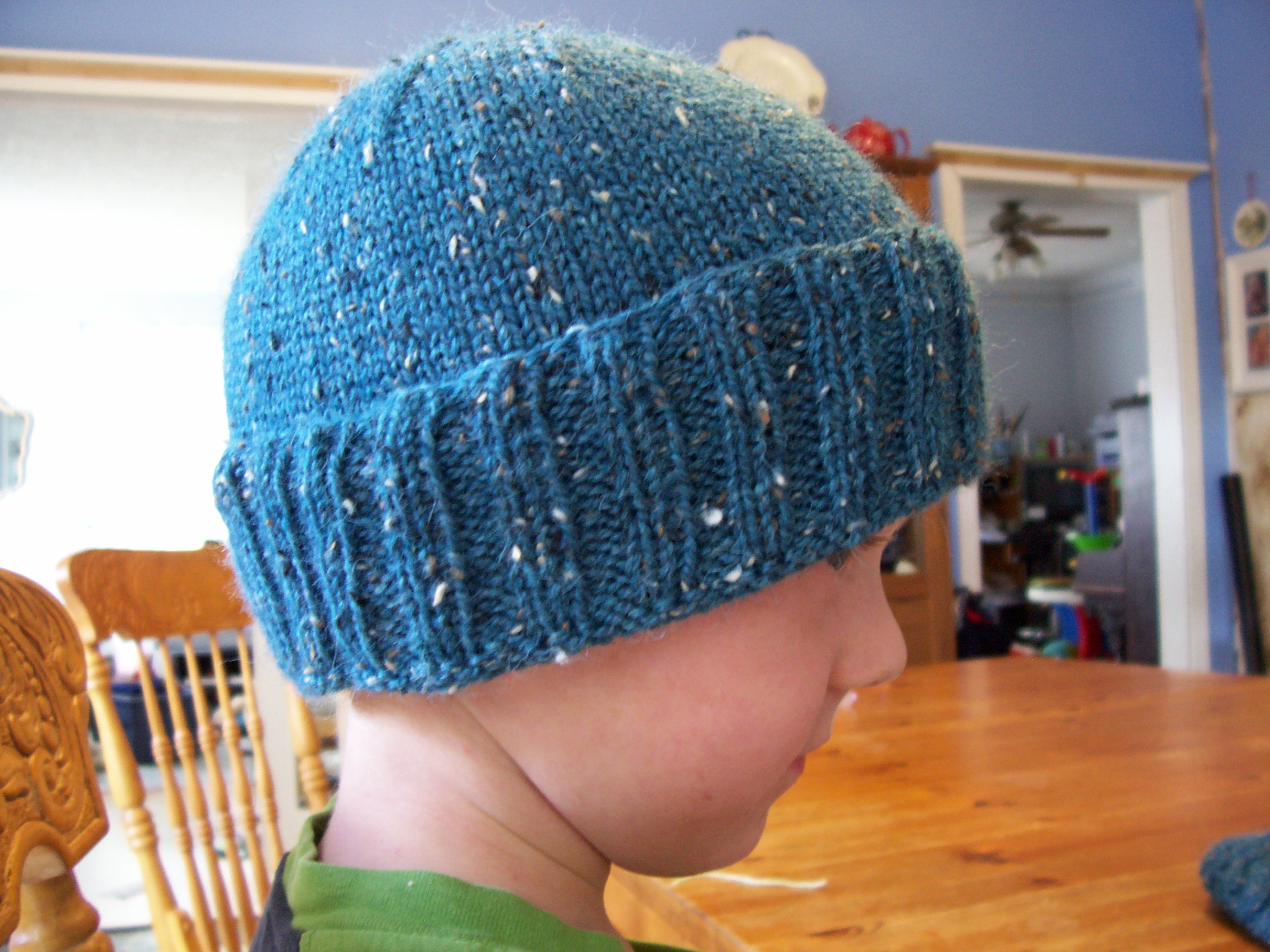
I just finished up this chemo cap for a small friend of mine. It’s a bit of a merge between Kate Oates’ free Cheery Scrap Cap pattern and my own viking horn design, with some modifications thrown in. I’m pretty pleased with the result. 🙂

If you’re interested in making a similar one, here’s how I did this one:

I used Knit Picks Swish DK (instead of worsted weight) and size 5 US circular needles. I cast on 104 sts to make a larger version of the girls’ child-size hat (I basically added 2 more pattern repeats). I skipped the ear flaps this time, and knitted about 3/4″ of 2×2 ribbing before starting into the chart pattern. I used the girl’s pattern for this boy’s hat, but I left the heart part of the chart blank except for one tiny row of red dots.

As for the horns, you can download my pattern for them from Ravelry with this link: download now

May all the mighty warriors out there with battles to fight be strengthened by our love and prayers as we knit for them.

Fall Flowers

Here’s a little update to show you what I’m working on right now. I have a couple hats in the planning/knitting/writing stages, and I hope you’ll like them as much as I do!

The first is a bigger version of the Tulip Preemie Hat, sized for little girls. I like to test knit my patterns to be sure they’re actually what I think they are, so it’s taking me a lot longer to get this pattern re-written than I’d expected. Let’s just say that by the time this pattern is published, I’ll have knit it in every size, and quite unintentionally. I keep casting on, meaning to make a small size, but it ends up being enough stitches for a bigger size. This stitch is quite unpredictable. Either that or I just need to think more before casting on. Anyway, here’s a preview of it in the fingering-weight yarn. (There will be a dk version, too.)

I’ve also noticed that the cast-on technique makes a difference with this pattern. I used the long-tail cast-on for that version, and I don’t like it. It pulls up the tulip petals until they’re practically gone! Boo hoo. So I’m still tweaking.

And what a shame, too! I took such nice pictures of that darned hat. Like this one:

If you like the flower theme, I’ve got another idea brewing along those same lines. It’s been sitting on the back burner (or, more accurately, the shelf in my knitting room) for at least a year now, but I think I’ll give it a chance to …bloom.

Yes. I do love puns.

All Wound Up: The Yarn Harlot Writes for a Spin, by Stephanie Pearl-McPhee

Who is the Yarn Harlot? She is the inner voice of knitters everywhere. She writes what all of us are thinking, and she writes what only she could think of (and it’s up to you do decide which is which).

In this, her third collection of knitting and non-knitting-related essays (although she does try to use the word “knit” at least once in each, even if it’s in the last line), you’ll find some old favourites as well as some new ones. Returning are her elaborate love/hate letters to inanimate objects, mostly knitted ones. Missing are her hilarious “Dear Designer” letters; although, there is one that could have disintegrated into one if not, I think, for her personal relationship with Nancy Bush and a healthy realization that this particular train wreck was not, this time, the fault of the designer.

Appearing for the first time is a treatise on… *gasp!* — crochet. (Yes, I have a new appreciation for it now because of Stephanie Pearl-McPhee. Who would have thought it possible?)

Also returning are her insights into life, knitting obsession, and the insanity of teenagers. It’s clear that the Yarn Harlot spends most of her time thinking deeply and philosophically about all things yarny and yarn related, and we all get to benefit from her musings. As usual, she had me laughing out loud, and, unexpectedly, she about had me in tears a couple times, too.

Because of our dear Yarn Harlot, I could tell my husband that that it’s okay that I am a crytoscopophiliac because there’s a word for it and because apparently everyone else is one, too — except, of course, for him. He still thinks I’m crazy, but I think he’s about used to it by now.

I also discovered that it’s the non-knitters who are insane time-wasters, not me. Yay! (Some may beg to differ, but I prefer to be biased towards my own hobby, thankyouverymuch.) I don’t think I really needed her to tell me that, but it was nice to hear it just the same. Actually, I think that’s why we all love her so much: she makes us feel good and normal and like productive members of society, like knitting is the only sane thing that is holding the world together at its seams. (They are kitchener-stitch seams, of course.) And really, who doesn’t want to feel like that, while having a good laugh over a cup of coffee and a one-point knitting project?

I’d say that the Yarn Harlot has done it again.

And if you’ve read her books or blog before, you’ll know what I mean.

(And if you haven’t, and you like yarn or knitting even the teensiest little bit, then for the love of all things woolly, go and read something by her right now. You won’t regret it.

~~~

All Wound Up is due out in October, and I am privileged to have read an advance copy from the publisher for the purposes of review. They didn’t tell me I had to like it, but I was pretty sure I would. I love being right!

You can pre-order your copy here:

All Wound Up: The Yarn Harlot Writes for a Spin

Rumors of God by Darren Whitehead & Jon Tyson

Rumors of God: Experience the Kind of Faith You´ve Only Heard About
is a Christian book about the question, “What if the rumors are true?” We in North America so often hear stories about other people’s amazing faith; we read about God’s promises and mighty works in the Bible; we hear about miracles happening in other parts of the world; and we wonder, “Are these things really true? Does this apply to my life? Will God do that here, too?”

Darren Whitehead and Jon Tyson’s answer to those questions: yes.

Rumors is an all-encompassing book that looks briefly at every important area of the Christian life and offers a fresh perspective on each. Each chapter addresses a different rumor (ie. Generosity, Abundant Life, Love, etc.), talks about real-life examples of people encountering God, discusses how our mind-sets might be hindering our view of God’s perspective, and offers encouragement for the reader to pursue God in that area. The “how” isn’t addressed so much as the “why,” and for that reason, I really took my time reading this book. There was much to think about, consider, and try to apply to my life.

As I read through the first few chapters, I found myself actually breathing a sigh of relief. I had been hoping that there was more to God’s purpose for my life than filling in a spot in the nursery and getting a nicer house, and Darren and Jon say there is! I guess what I mean by that is that I had unknowingly become discouraged over the years, seeing my Christian friends pursue the same things as everyone else: more money, more happiness, more acceptance by the group. Where was the abundant life Jesus had promised? Wasn’t it supposed to be about more than just stuff?

This book has given me a fresh perspective on God’s bigger plan that I desperately needed. I had been planning to give my copy away (I received it complimentary from BookSneeze), but I’ve decided to keep it instead so I can refer to it again and again through the years. Like I said, I still have to figure out the specific “how” that applies to me and the way God designed me, but I know that when I need inspiration, I can refer back to Rumors for a breath of fresh air. I hope you’ll get yourself a copy, too, and find out that the rumors are true.

knit, Swirl!

Eye candy. Inspiration. Drool-worthy. Shelf jewelry.

And all those words describe only the book. What you can make with this book deserves a whole new set of adjectives.

A “Swirl” is a sweater. Or is it a jacket? Or is it a piece of art that you can wear? It’s definitely a chance to pick your favourite yarn and really show it off and enjoy it. It’s also a way to use up large amounts of yarn from your stash.

The construction behind the Swirl involves a circle or oval, knit from the outside in, which then morphs into an additional shape that forms the sleeves and neckline. This is all knit in one piece, then joined together by sewing one seam under the arms. That one seam provides some structure to the garment, which is largely drapey. The collar is basically made by the top of the circle or oval, folded over. Some of the Swirls can be worn either right-side-up OR upside-down, giving them a lovely versatility in collar size and letting you choose your look for the day.

The book knit, Swirl! is basically one pattern, repeated in all its variations of shape and yarn type. Since your Swirl can be either a circle or an oval, with either off-centre or on-centre sleeves (creating either large or small collars to complement either long or short waists), it really can take a while to choose which variation of the Swirl you would like to knit first. Some are more tailored looking, while other are more flowy and artsy. The creator of the Swirl really took her time working out all the differences in stitch count for the varying gauges and fits, and she provides great directions and tips for choosing your perfect Swirl. For the visually minded, there are also detailed diagrams for each variation.

I loved the photos and layout of this book. Each Swirl is shown in different ways, so you can really see what they look like on. Since we knitters obviously can’t try on our clothes before we make them, it’s great to have lots of visual clues beforehand to help with our decisions. The only problem is that every single photo is so pretty, I wanted to choose them all! And I also want to wear my Swirl on a beach, with wind gently tussling my hair, enjoying the coziness of the luxurious yarn on my neck. (But since a Swirl uses as much yarn as a blanket, I think I’ll have to settle for something a little more economically feasible than a cashmere blend. Boo.)

But, the good news is that the Swirl I’ve settled on is knit up in worsted-weight merino, and I can get that at Knit Picks for a pretty decent price — and it feels good on, too. (I love my Classic Lines Cardigan, knit up in Knit Picks lace-weight merino; it feels like I’m wearing a light yet cozy cloud.) Now, the hard part: choosing a colour. Oh, and finding the space in my ever-growing queue!

So, what are you waiting for? Go knit a Swirl!

[box]Some of the links in this article are affiliate links. But, I only recommend things I actually like and use myself.[/box]


Vacation Knitting!

Because what would a vacation be without yarn?

I knit up the last piece of Eva’s sweater, and I think I’ll continue the vacation vibes by sewing it up this week. It’s a Duffle Coat by Debbie Bliss knit up in Knit Picks Swish DK in Amethyst Heather.

I also cast on these Wallflower socks, which I’ve been drooling over since I took the Two Hands, Two Colours class from Sally Melville at my local yarn shop. The Knit Picks Chroma is so sticky! I love it.

Before I could start them, though, I had to finish up these Jaywalker socks that were on the needles I needed. (The poor things had fallen victim to the New-yarn-arrived-so-I’ve-moved-on-to-another-project-and-I’ll-get-back-to-you-later Syndrome. I hear it can sometimes be fatal if left too long. As it was, they barely escaped without serious side effects. Thankfully, after some stitch counting, pattern puzzling, head scratching, husband laughing, and more stitch counting, they’ve pulled through the crisis and might even match — stitch-wise, not stripe-wise. I sometimes like a good, confusing, mismatched stripe.)

I also tried out a new stitch pattern I’d had brewing in my mind for a manly scarf. (For some reason, my husband says I don’t knit for him. I don’t know what he means! After all, that pair of socks I knit for him last year will be ready as soon as I sew in those last three ends. Sheesh.) Right. So, here’s what I came up with:

As you can see, it went great.

And, last but not least, I worked on some sizing for the child-size version of the Tulip Preemie Hat. I was aiming for a one-year-old size to fit Eva this winter, but I think it may need some work. See what buying a written pattern does for you? It saves you time and frustration because someone else has been frustrated for a time instead.

Oh yeah! I don’t know how I forgot about this one, but I also cast on another Ten-Stitch Blanket with some yarn I picked up in a shop near the cottage. It’s Bernat Mosaic in about five different colourways. It’s acrylic (bleah), machine-washable and -dryable (yay!), and WAY cheaper than the Noro Aya I used in the same pattern for my sister-in-law’s wedding present (yay again!). Even though I strongly believe we knitters should never have to sacrifice using quality natural fibres, my wallet doesn’t always agree with me. And, I have to say, the colours in this yarn are gorgeous, the mixture of them is more to my taste than the Noro’s was, and even though my brain knows I’m feeling acrylic instead of a luscious blend of silk, cotton, and wool, my fingers can’t really tell the difference. Plus, I’ve only come across one tiny knot so far, which is far less than the ten-dollar-a-ball, “high quality” Noro can boast. Oh, and when my kids spill cheerios all over it, make a fort out of it, and just generally rub their kidliness all over it, I won’t care because I can throw it in the washer.

To top the vacation off, I made the mistake of heading to Wool-Tyme for their tent sale, where I picked up a pile of yarn for ridiculously low prices. I’m quite excited about some of it (sock yarn and bamboo DK in vibrant greens and purple), and some has me scratching my head wondering why I thought I needed six huge balls of bright orange acrylic yarn just because my kids like that colour.

Good yarn that will be made into preemie hats
Questionable yarn that will nevertheless make my kids insanely happy as a blanket

Now this orange yarn, on the other hand, is something I consider a good buy. Eco Wool, on sale!

I’m picturing it, along with the leaf green, as stranded mittens for the boys to keep their little fingers double cozy this winter. Makes me feel all good and motherly.

Now, to stay home, stop spending money, and happily work my way through my stash.

Amigurumi Knits by Hansi Singh

First of all, I have to say, “Kraken!” How could I resist a book with a pattern to make a giant squid? (My giant squid is here, if you want to see it.) Not to mention the hermit crabs (Seriously! How did she figure out the math for that three-dimensional, stuffed spiral that makes up the shell? I am in awe.), the earthworms, the unconventional veggies (eggplant, anyone?), and the Loch Ness Monster. This book is a treasure trove of weird, little-boy-obsession patterns. Which works well for me, because I have four of them.

Now, as to the specifics: there’s the standard how-to section, with instructions on grafting, picking up stitches, and short rows, all of which are heavily featured in her patterns. The short-row shaping, especially, is extensive. There are tips on stuffing your toys and finishing them up, too. One thing I liked was that many things had minimal sewing required; most appendages are knitted on by picking up stitches. (Except for those darn hermit crab legs. They, of which there are many, all had to be sewed carefully inside the shell opening, hiding the stuffing and not mangling their directionality as I went. Ick.)

Another plus: many incomprehensible written instructions were made clear by pictures illustrating what she meant. Some things just can’t be expressed adequately in words, and I’m very glad I didn’t have to try to read the designer’s mind. Having said that, there were a couple spots where I looked for the pictures and didn’t find them. That, after knitting up the other, really well documented patterns, was really disappointing. So I guessed as best I could, and things worked out well. (But if I hadn’t started off with the Kraken, I don’t think I would have fared as well.)

My current love of the book, after having knit up the Kraken, two Hermit Crabs, and two Loch Ness Monsters, is about 4 out of 5 stars. I will never again knit another hermit crab as long as I live, if I can help it. But the Loch Ness Monster was a comparatively simple knit, and if you add some crinkly plastic gift wrap into the flippers to make them crackle, they can make a great and …unique… baby gift. My son has requested a giant-sized squid to use as a pillow, but I’m hoping he’ll forget that request.

After having so much fun with all the short rows (I’m not kidding) and finally understanding what they’re for and how they work, I’ve found that my knitting in general has gotten a lot better. This book was one more step on my way to becoming a really great knitter.

Oh, one last thought before I go: don’t be afraid to stuff! My poor little menagerie has gotten a little floppy since I made it. Poor Orangey, especially, can barely even hold his head up, poor dear. (Yes, my kids are extraordinary namers. I believe the formula is “pick its defining characteristic, then add a -y to the end of it.”)

Let me know what you thought of the book. Have you made any of the other patterns?

Hand-Painted Preemie Hat

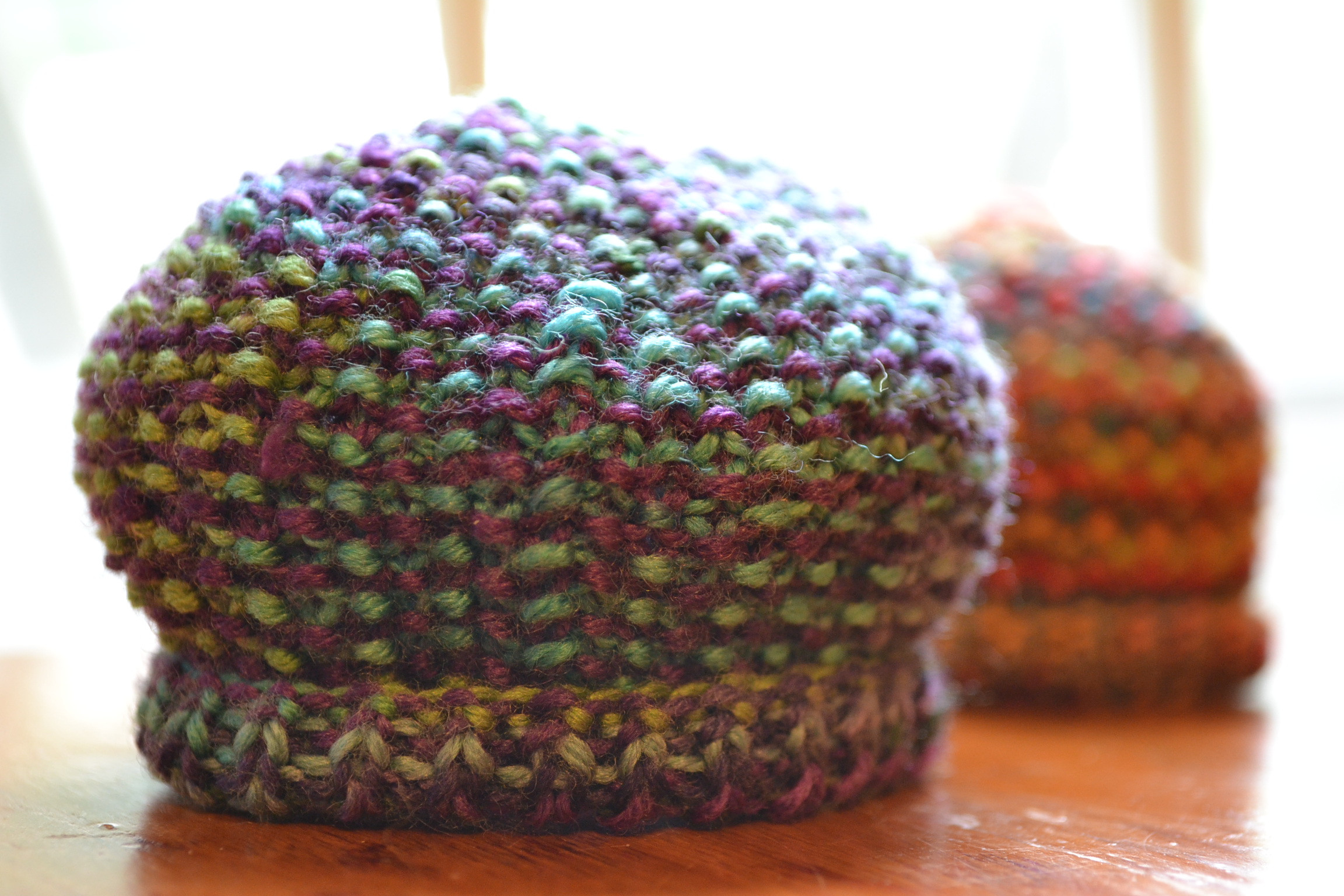
I love buying hand-painted yarn, but then I’m inevitably disappointed when I knit it up. The gorgeous, vibrant colours suddenly pool or stripe in weird ways that make the ugliest little hats. But when I use a textural stitch, like seed stitch, suddenly the yarn regains its charm and the hat becomes delightful!

You can see how the stitches break up the lines of colour and give it an almost tweedy effect.

Top view

I’ve worked out the top decreases in the seed stitch pattern to keep the effect going right up to the top. I’ve tried decreasing in seed stitch a couple different ways over the years, but this pattern uses my favourite. I hope you like it, too.

The pattern for these little hats includes sizes from micropreemie up to a full-term newborn. You’ll need size 2 US needles for working in the round. I prefer using two circs, but any technique will do.

You can grab the free download here:
download now

UnBaby Blanket

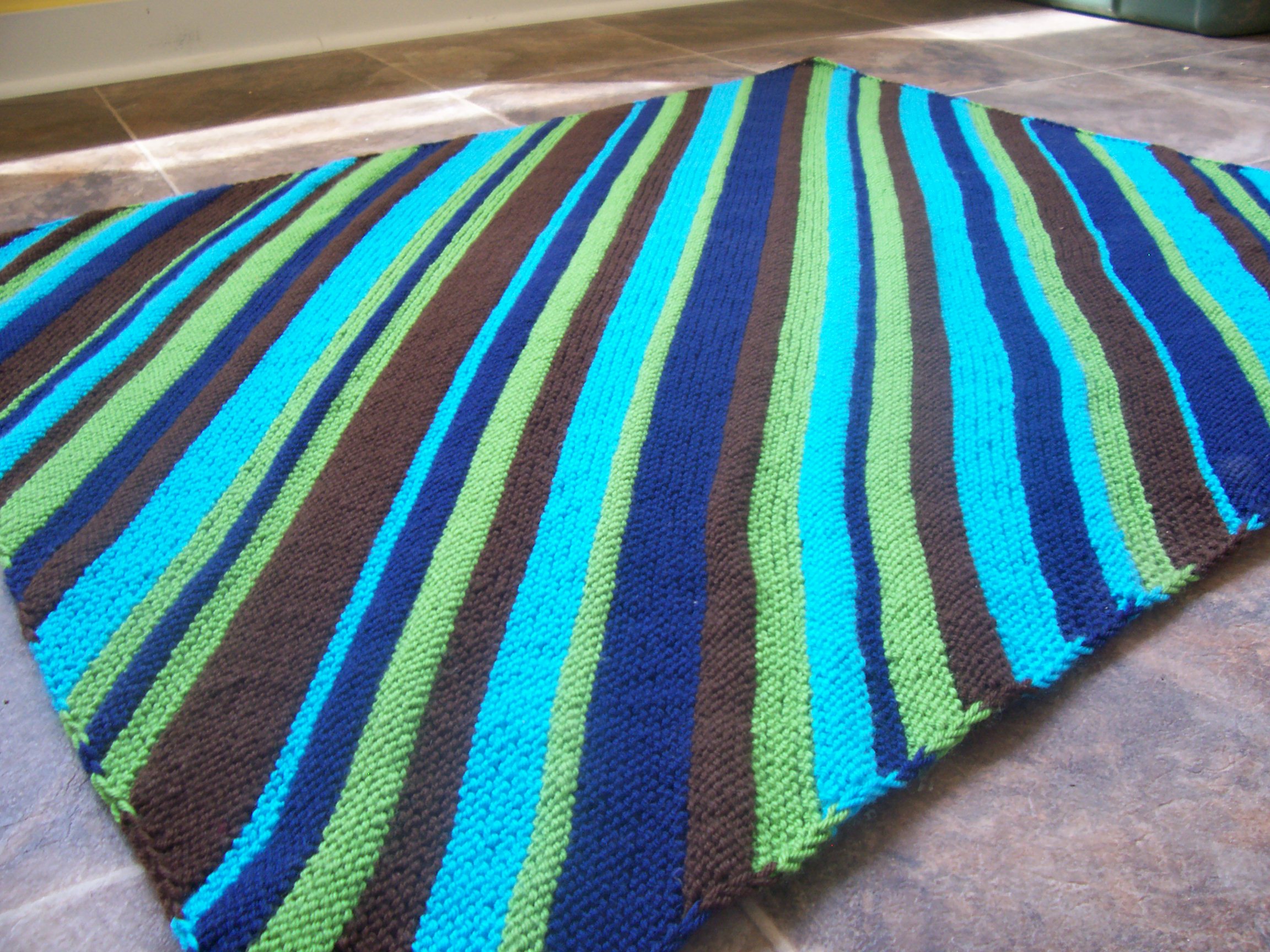
When I saw the blanket my sister was making, I knew I had to have one. The diagonal stripes, the vibrant colours, the texture — they all conspired to hijack my knitting plans, and I happily let them.

Her simple design has been a hit, and not just with me. I am excited to present the recipe here so you, too, can make your own one-of-a-kind, easy-yet-interesting-to-knit unbaby blanket. I call it “unbaby” because there is no way these colours would ever end up in the baby yarn section, and there is a distinct possibility that you, like me, will want one in your own size, too.

One of the blanket’s best features, besides its bold stripes, is that it is reversible but not identical on both sides. Don’t ask me which side I prefer because I have been trying to decide that very thing since I began knitting it, and I still can’t make up my mind. Is it the clean lines and bumpy softness of the “right” side, or the varied textures and visual extras on the “wrong” side? You know what? Forget right and wrong — I think I should just name them something else that implies how great each side is. How about Ruby and Clementine? (I’ll never be able to use those names for children, anyway, so they might as well go to a good home.)

Here are some things you need to know about the pattern:

You’ll need at least four balls of 5 oz/140g medium worsted weight yarn. (I say “at least” in case you want an adult-sized one. In that case, get two in each colour… at least.) We used Red Heart Soft Touch for ours (which I know is a variation on my usual Knit Picks preference, but it was available, washable, and pretty darn soft to boot). Steph chose the dark brown, navy blue, aqua blue, and bright green as her colours, and I loved them and copied her. If that’s not to your taste, I’d simply recommend two dark colours and two vibrant colours in your mix.

Needle size was 9 US for me and 8 US for Steph, and they both worked well. The point is to have a nice, relaxed stitch for a soft fabric.

The pattern is written for beginners and includes tips on some techniques which you may or may not have already come across. I want your blanket to be beautiful, so I told you everything I did to make mine great.


And now, without further ado, here is the link where you can grab it for FREE:

download now

How to Knit a Hat

You have yarn. You have needles. You have cold ears on a blustery day. (Or you’re having a bad hair day. It happens to the best of us.)

How do you make a hat out of thin air, without a pattern? How do you move from knitter to designer? How do you become the master of your hat destiny?

That’s easy. Let me explain.

First, you cast on. (Simple, right?) There are two ways to figure out how many stitches to cast on. The first one is very mathematical and by-the-book, and the second one might make you laugh — but hey! It worked for me for years, and it’s very fly-by-the-seat-of-your-pants, which can really come in handy sometimes. Right?

So, method one: Knit up a gauge swatch. If you’ll be knitting your hat in the round, you knit your gauge swatch in the round. If you want to knit your hat back and forth on straight needles, knit up your gauge swatch in the same manner. Once you know how many stitches per inch that particular yarn works up to on those particular needles, you simply measure the head you’re knitting for. If it’s 20 inches around, and your gauge is 5 stitches per inch, then that’s 20 X 5, which is 100 stitches. Easy peasy. To recap, multiply your head circumference by your stitches per inch gauge, and you have the number of stitches to cast on to fit that head with that yarn.

Now, the second method. (Don’t laugh!) I seriously used to just cast on my stitches, using either the long-tail method or the knitted-on method, then hold them up to my head to see if it looked about right. The only catch is, you have to know how that cast-on method will change once it’s been knitted for a few rows. I found that the long-tail method would give me a fairly accurate reading if I [somewhat] evenly spread the stitches out on the needle in a way that was not too stretched or too crowded. But with the knitted-on method, I had to stretch the stitches as far apart from each other as possible to see how long they’d be once knitted up. Then, I’d hold the needle up to my head and swing it around from a beginning point at the back, pivoting it around my head to see if half the stitches would reach to the centre of my forehead.

Yes, I really did that.

The next step, once you have about enough stitches on your needles, is to make sure they’re divisible by either 9, 10, or 11. If they’re not, fake it. Either drop a stitch or two off, or add a stitch or two on. You’re planning ahead right now for when you get to the decreases at the crown. (p.s. For adults, multiples of 10 or 11 are best, and babies’ or preemies’ hats are probably better with 9 or even 8. Kids are in between, so pick whatever you want.)

Once you have your cast-on number in a happy place, you’re ready to choose the edge. If you want a rolled edge, just start knitting in stocking stitch (knit the right-side rows, purl the wrong-side rows if you’re knitting flat, and just knit every row if you’re knitting in the round). If you want it stretchy, try some ribbing. (Just make sure the ribbing you choose divides evenly into your stitch count. One-by-one ribbing will work on any even number, and two-by-two will work on any even number which you can then divide a second time evenly, like 60 or 80.) If you want it a little loose, garter stitch will work. Or, you could just start into a lace repeat that goes with the number of stitches you cast on. Really, there are no limits.

You work in that edging until you’ve had enough, then you switch to something else if you so desire. Maybe you want ribbing for two inches, then stockinette for the rest of the hat. Or maybe you’d like a hat that’s ribbed right up to the top. Maybe you want to plan on your hat being really long so you can fold the bottom up, or maybe you’d prefer a hat that ends above your ears. It’s so completely up to you now! You don’t need no stinkin’ pattern anymore.

The only other thing you’ll need to do is decrease at the crown. Basically, when you’re about 2 inches away from the top of your head, start to decrease. Try the hat on to see if you’re there, or just eyeball it. If you’re making a baby-sized hat, you probably won’t even need 2 inches to decrease. My subconscious rule of thumb, which I’m just now realizing to myself for the first time in order to communicate “how I do this,” is to knit about 3/4 of the hat length, then use the final 1/4 for the decreasing. Knit stitches are such amazing, naturally proportioned things. Now matter what yarn I’m using, or what stitch count, or what size needles, that ratio seems to just work. Try it out. (And for goodness’ sake, tell me if I’m wrong! But I bet if I am, it’s just by a little bit.)

Here’s another tip: if it looks too short and fat, it probably is. Think about it. We are people who are constantly looking either in the mirror at our own heads or at other peoples’ heads. You know what a head should look like. If you think the hat doesn’t look like a head shape, you’re probably right. If you think it looks about normal, you’re also probably right.

Now, to the specifics of decreasing. Remember when you made sure your cast-on number was divisible by either 9, 10, or 11? Here’s where you take advantage of that. Let’s say you’ve chosen multiples of 11 (which are quite fool-proof, if you ask me). You’re going to *knit 9, k2tog* all the way around your hat. That’s right. If you’ve cast on 99 stitches (which is a perfectly normal adult-size number using worsted-weight yarn and size 6 or 7 US needles), you’ll repeat that decrease section 9 times because 99 divided by 11 is 9. Multiples of ten mean a *k8, k2tog* around strategy, and multiples of nine mean — you guessed it! — *k7, k2tog* around.

Do your decrease rounds every other round so they’re not all squashed together. (Unless, of course, you want to try something different and decrease really quickly in the last inch of your hat. Hey, you could call it a “design element.”) Every subsequent decrease round, you will, of course, be knitting fewer stitches between each k2tog. One fewer stitch per repeat, in fact. (Picture “k8, k2tog; k7, k2tog; k6, k2tog; k5, k2tog…” and so on, down to “k2tog” all around.) Once you’ve decreased down to your last *k2tog* around, don’t knit another round. Just stop, cut your yarn, thread the end through the rest of your stitches, and draw it tight. Wow. You just made up a hat. All by yourself.

(If your hat was knit in the round, you’re done. If you knit it flat, then add one more step: sew the seam. I use a flat stitch to sew my seams shut. Your best bet is to have a good knitting reference book around with a couple options in it so you can pick and choose which one will look best with the stitch pattern you’ve chosen.)

Now, since we’re being creative and rebellious by making up our own darn hats, feel free to fiddle with the decreases, too. Why not try ssk and have the decrease lean the other way? Or why not decrease in whatever pattern you’ve chosen? When I make a hat that’s ribbed right up to the top, I do my best to keep the flow of the ribs going for as long as I can. I still take about 2 inches to get the decreases done, but I might space them out in different ways. Really, yarn is pretty forgiving stuff. And if it’s not, then I’m the boss! I can just rip the stupid stuff out and do it over again. Who does this hat think it is, anyway?

Right. So, my late-night tantrums aside, I hope you’re starting to get the picture here. Hats are the perfect project on which to try out your designing skills. (Well, except for scarves. I mean, they don’t even have decreases, for goodness’ sake!) And once you get comfortable with the basic structure of a hat, you can start to really push the limits with stitch patterns and other random embellishments.

And now that you know all my secrets, I’ve probably put myself out of business before I’ve even really begun. But I am deciding not to care because knitting is just so darned awesome, and everyone should love it as much as I do.

So there.